
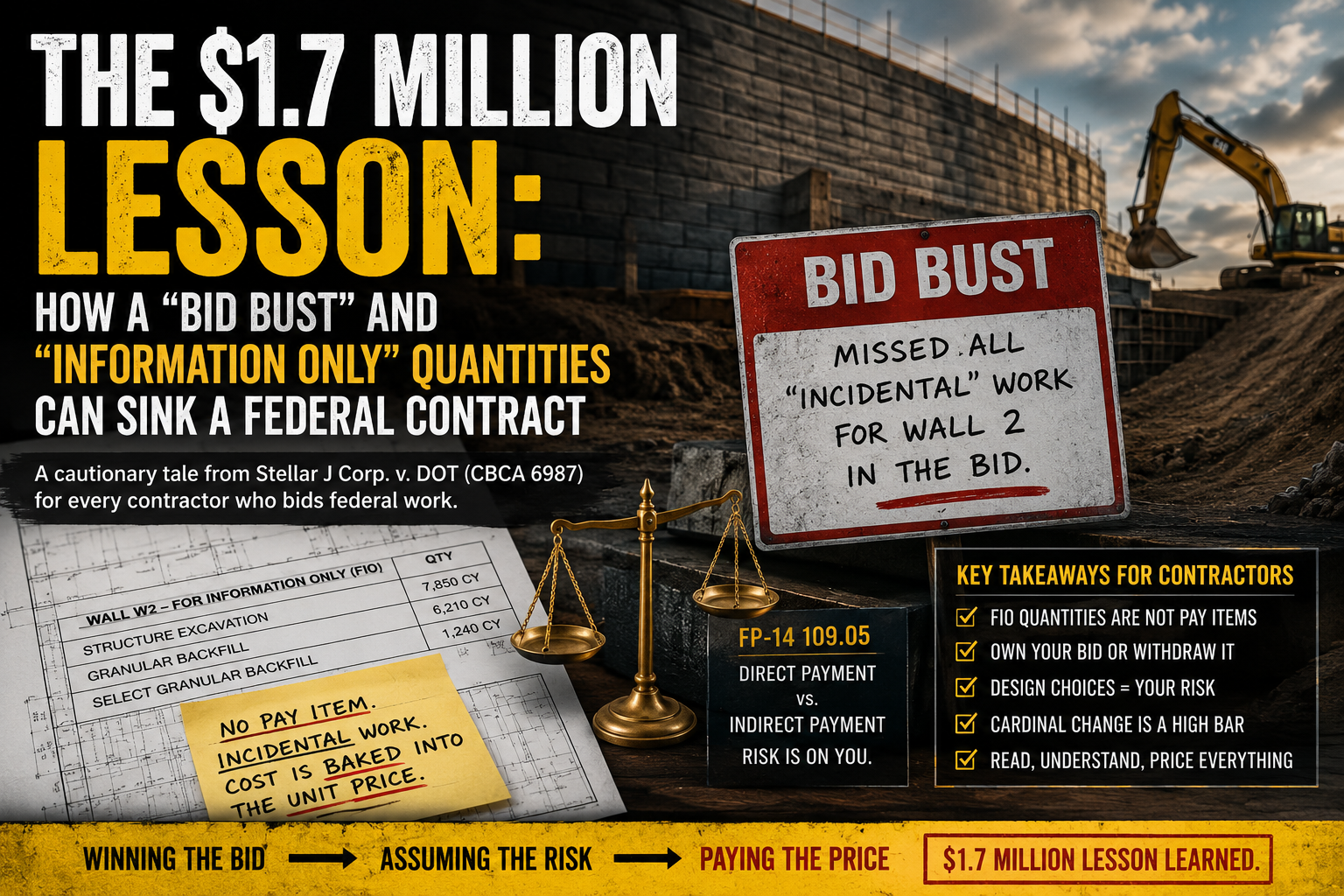
The $1.7 Million Lesson: How a "Bid Bust" and "Information Only" Quantities Can Sink a Federal Contract
Introduction: The High-Stakes Gamble of the Bid Opening
In the realm of public works procurement, bid opening day is a crucible of adrenaline and calculated risk. To the uninitiated, being named the lowest bidder is the ultimate victory. To the seasoned specialist, however, a massive "leave on the table" is not a cause for celebration—it is a flashing red light. In the high-stakes environment of federal infrastructure, winning the contract is merely the first step; the true challenge lies in surviving the risk allocation established in the solicitation.
The case of Stellar J Corporation v. Department of Transportation (CBCA 6987) stands as a definitive cautionary tale for the modern contractor. It illustrates how a combination of "bidding bravado" and a fundamental misunderstanding of Federal Project 14 (FP-14) specifications can lead to a $1.7 million lesson in contract law. This dispute explores how a contractor won a design-build project but lost millions before the first excavator arrived on site, simply by failing to respect the distinction between "Contract Quantities" and "Information Only" data.
The "Bid Bust" Red Flag: When Your Numbers are Too Good to be True
In federal contracting, winning a bid by a wide margin is often indicative of a looming disaster rather than a competitive advantage. In the Stellar J solicitation, the disparity in pricing for the Wall 2 (W2) Mechanically Stabilized Earth (MSE) wall surface was staggering. While the four other bidders submitted an average price of 65.25persquarefoot∗∗,StellarJbidamere∗∗22 per square foot.
This massive delta triggered an immediate "bid bust" realization within the company once the government requested bid confirmation. An internal email from the project manager on November 28, 2017, captured the contemporaneous panic:
"Bid Bust: Missed all ‘incidental’ work for wall 2 in the bid."
The contractor had failed to utilize the "For Information Only" (FIO) quantities for their intended purpose: to provide a basis for pricing work that lacks a dedicated pay item. By the time this omission was recognized, the contractor was already positioned for a catastrophic assumption of risk.
The Mirage of "For Information Only" (FIO) Quantities
The heart of the dispute centered on Drawing M.20, which included a table of "For Information Only" quantities for Wall W2. In the world of federal procurement, the label "For Information Only" is a legal term of art. It is synonymous with a "Non-Pay Item."
Under FP-14 subsection 109.05, the contract establishes a rigid dichotomy between Direct and Indirect Payment:
- Direct Payment: Reserved for items explicitly measured and listed with a pay item number in the bid schedule.
- Indirect Payment: Work for which no direct pay item exists is deemed a "subsidiary obligation" of the contractor. Compensation for this work is legally considered "baked in" to the unit prices of other bid items.
The Board of Contract Appeals confirmed that the following three materials were subsidiary obligations because they lacked independent bid items for Wall W2:
- Structure Excavation
- Granular Backfill
- Select Granular Backfill
Desperate to recover costs during the Request for Equitable Adjustment (REA) phase, the contractor attempted to utilize unit prices from Section 208 (Structure Excavation and Backfill of Major Structures) to claim costs for Section 255 (MSE Walls) work. The Board rejected this maneuver, noting that Section 208 items were for "other elements of the project," not Wall W2. Because the FIO materials were "incidental work," the contractor was required to include their costs in the $22 per square foot unit price for the wall face.
The "Big Boy" Fallacy: The Voluntary Assumption of Risk
When the government requested bid confirmation due to the suspiciously low price, Stellar J faced a pivotal decision: withdraw the bid due to a clerical error or stand by their numbers. Choosing the latter, the contractor leaned into a culture of accountability that ultimately proved legally fatal. Clayton Thompson, the project manager, later testified:
"We’re big boys. . . . [S]ometimes if we make a mistake we own it."
This bravado resulted in a total voluntary assumption of risk. By confirming the bid without revision—and without even having their design subcontractors (Golder/Keystone) on board to verify the feasibility of the $22 price—the contractor effectively waived any future claim under the Spearin Doctrine. One cannot claim they were "misled" by government estimates if they consciously chose to ignore those estimates during the bidding and confirmation process.
Safety vs. Solvency: The 0.7H Ratio and the Government’s Recalculation
As a design-build project, the engineering risk sat squarely with Stellar J. Their design subcontractors, Golder and Keystone, prioritized "life safety" over the contractor’s budget. To meet minimum safety requirements, the designers utilized a 0.7H reinforcement ratio (strap length to wall height) and ultimately exceeded it to ensure stability.
The engineering consequences were profound: a mere 4% increase in the actual wall surface area necessitated a 98% increase in excavation volume. However, the most devastating blow to the contractor's "misled" argument came during the hearing. When the government recalculated the original FIO estimates based on the baseline design assumptions, it found the quantities should have been 3% to 9% less than what was shown on the drawing. This proved the government’s estimate was actually conservative, and the massive volume overrun was the direct result of the contractor’s own design choices and construction means and methods.
The Cardinal Change That Wasn't
Stellar J sought to recover their $1.7 million quantum by invoking the "Cardinal Change" doctrine, arguing that the excavation requirements were a "drastic alteration" of the work. The Board of Contract Appeals dismantled this theory based on two mechanics:
- Design Control: Since the contractor designed the wall and chose the reinforcement lengths, they could not claim the government "ordered" a cardinal change.
- The VEQ Threshold: Under the Variation in Estimated Quantity (VEQ) clause (FAR 52.211-18), an equitable adjustment is generally only triggered if a unit-priced item varies by more than 15%. Because the wall face—the only contract quantity at issue—only increased by 4%, the contractor failed to meet the threshold for relief.
The final ruling was unambiguous: the contractor’s costs were the result of bidding errors and design choices, not a breach by the government. The appeal was denied in its entirety.
Conclusion: A Provocative Takeaway for the Modern Contractor
The lesson for the public works specialist is clear: "For Information Only" is not a safe harbor; it is a warning. In an era of increasingly complex design-build requirements, the traditional bidding process can quickly become a trap for even the most experienced "big boys."
If a material volume is labeled FIO, it is an indirect pay item. Period. If you fail to perform your own take-off or ignore the FIO quantities in a rush to win the bid, you are not just "owning a mistake"—you are signing a blank check for the project’s excavation and backfill costs. In modern federal procurement, precision in the bid is infinitely more valuable than bravado in the field. The Board has made it clear: if you design it and you bid it, you own it.