
Jaw-Dropping Audit Finds From the 2025 ODOT Audit
https://substack.com/@governmentgonewild
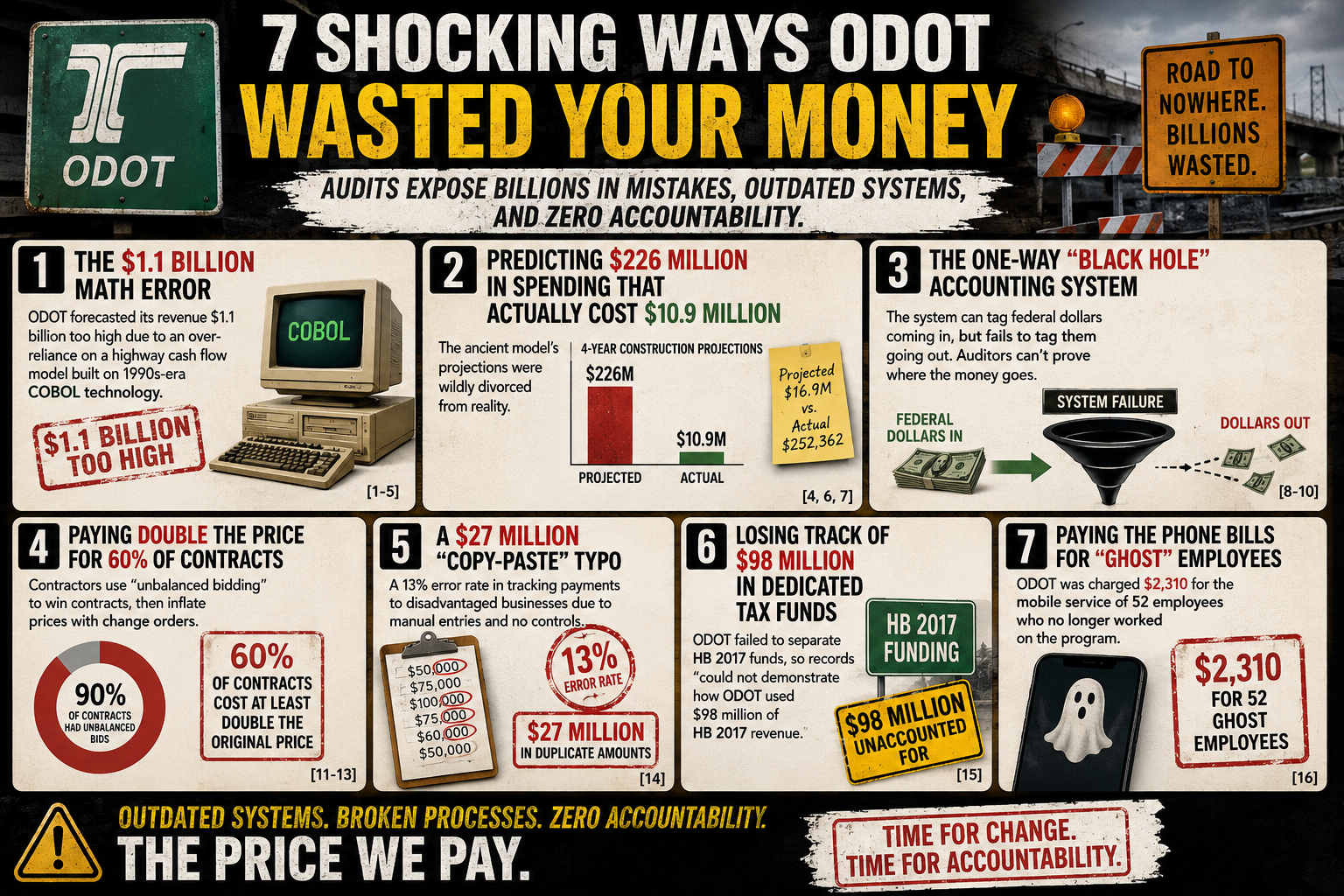
The $1.1 Billion Math Error Driven by an Ancient "COBOL" Computer: ODOT accidentally forecasted its revenue $1.1 billion too high when developing its 2023-2025 budget. Auditors discovered this massive error was driven by an over-reliance on a highway cash flow model built on 1990s-era COBOL technology. ODOT's own IT staff admitted the system is so old and complex that it would take "a tremendous amount of effort to determine what exactly it is doing" and program staff couldn't even tell whether it was working properly.
* Predicting $226 Million in Spending That Actually Cost $10.9 Million: Because of the aforementioned ancient computer model, ODOT's cash flow projections were wildly divorced from reality. Over a four-year period, the model forecasted $226 million in construction expenditures for specific federal projects where ODOT's actual expenditures only ended up being $10.9 million. In one hilarious instance, a project was projected to cost $16.9 million one year and $16.6 million the next; the actual costs were $252,362 and $49,757.
* The One-Way "Black Hole" Accounting System: Federal auditors had to issue a catastrophic "disclaimer of opinion" because ODOT's accounting system physically cannot prove where its federal grant money goes. Auditors found that the system successfully attaches federal tracking identifiers to incoming revenue, but completely fails to attach those identifiers to the outgoing contractor expenditures. When asked to reconcile expenditure data for roughly 1,700 projects, both ODOT and the auditors simply gave up because the system couldn't produce the required fiscal year report.
* Paying Double the Price for 60% of Construction Contracts: A random audit of over 400 ODOT construction contracts revealed that contractors are routinely gaming the system through "unbalanced bidding". Contractors intentionally bid unusually low or high on specific line items to win the contract, and then use change orders to inflate the price later . Auditors found that 90% of contracts contained unbalanced bids, and in 60% of the contracts, the state ultimately ended up paying at least double the original line-item price.
* A $27 Million "Copy-Paste" Typo: When tracking the money it pays to Disadvantaged Business Enterprises and subcontractors, an internal audit discovered a staggering 13% error rate. Of the nearly $210 million recorded in their compliance database for 2022, over $27 million were duplicate amounts. This happened simply because staff were allowed to make manual corrections and type directly into the database without adequate controls.
* Losing Track of $98 Million in Dedicated Tax Funds: In 2017, the Oregon legislature passed a massive funding bill (HB 2017) with strict legal requirements dictating exactly what the new tax revenue had to be spent on. However, because ODOT failed to separate this money into distinct accounting funds, an audit found that agency records "could not demonstrate how ODOT used $98 million of HB 2017 revenue" [15].
* Paying the Phone Bills for "Ghost" Employees: While reviewing ODOT's federal project expenditures, auditors caught the agency blindly approving telecom invoices without checking the employee roster. A federal program was charged $2,310 for the mobile service charges of 52 employees who no longer even worked on the program.