
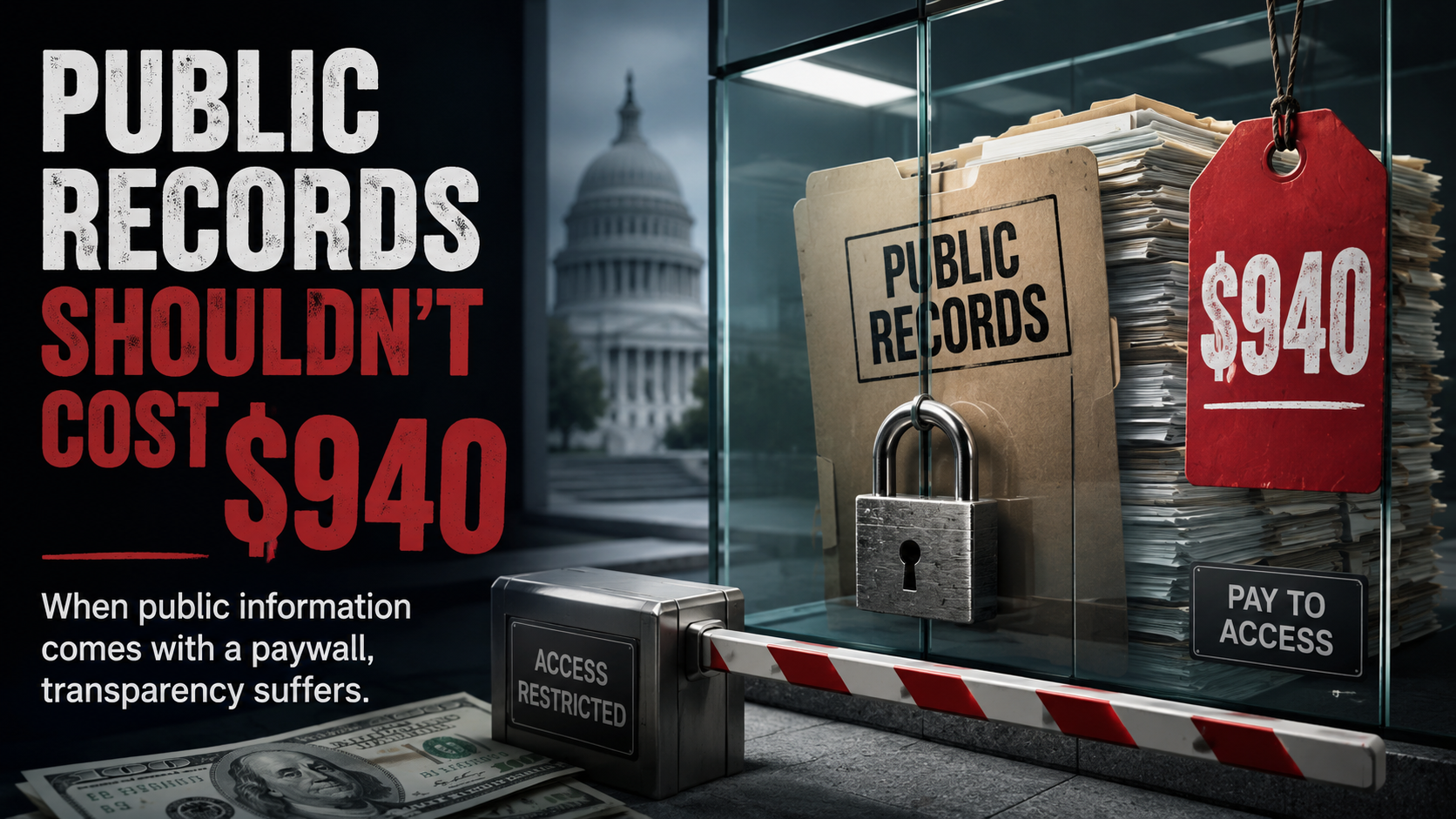
Public Records Should Not Come With a $940 Cover Charge
Public records are supposed to belong to the public. That is the whole point.
They are not private agency property. They are not a luxury product. They are not some premium government subscription service. They are records created by public employees, public contractors, public consultants, and public agencies using public money.
So when a taxpayer asks to see how taxpayer money is being spent, the response should not be a $940 invoice.
But that is exactly what happened.
A public records request was submitted seeking records showing public consultant billing, labor charges, invoices, and payment records connected to taxpayer-funded public work. The request was not for personal information. It was not for trade secrets. It was not for gossip. It was for records showing how public money was billed, reviewed, approved, and paid.
The agency’s estimate came back at $940. The invoice showed 24 total labor hours, 0.5 hours waived, and 23.5 hours charged at $40 per hour.
That means before the public can even see whether taxpayer money is being managed responsibly, the public is told to pay almost a thousand dollars.
That is not transparency. That is a paywall.
The Public Has a Right to Know Where Public Money Goes
Public records laws exist because government accountability requires public access. People cannot meaningfully question spending, oversight, contracting, billing, or agency decision-making if the documents needed to evaluate those issues are locked behind expensive fees.
Public-interest records are different from private convenience records.
If someone asks for a copy of a personal file, that may mostly benefit that person. But when someone asks for records showing public spending, consultant charges, agency oversight, or taxpayer-funded project administration, that is not private curiosity. That is public accountability.
In the fee waiver request, the stated purpose was public review, education, and transparency regarding the use of taxpayer funds. The request explained that the records were not sought for resale or commercial use, and that findings may be shared with contractors, taxpayers, small businesses, public officials, and the general public.
That is exactly the kind of request a public-interest fee waiver should protect.
Charging $940 Chills Public Oversight
Here is the constitutional problem: access to government information is meaningless if ordinary people cannot afford to obtain it.
The First Amendment protects speech, petitioning government, public criticism, and civic participation. But those rights become hollow when the information needed to criticize government is priced out of reach.
No, that does not mean every public record must always be free. Agencies may have legitimate costs. But fees should not become a barrier that prevents ordinary taxpayers from investigating how their own money is being spent.
A $940 invoice does not just recover staff time. It discourages scrutiny.
It tells citizens:
You can ask questions — but only if you can afford the answer.
That is a problem.
“Actual Cost” Should Not Become a Shield Against Accountability
Agencies often justify public records fees by pointing to labor time: locating records, reviewing records, redacting records, preparing records, and processing the request.
Fine. Some cost recovery may be reasonable.
But “actual cost” should not become a blank check to bury public oversight under labor estimates.
Public agencies already maintain these records. Billing records, invoices, payment records, labor charges, and project administration documents are not exotic documents. They are basic government accountability records.
If a public agency cannot produce records showing how public money was spent without charging hundreds or thousands of dollars, that itself raises a serious transparency problem.
Because the public paid for the agency.
The public paid for the staff.
The public paid for the contractors and consultants.
And then the public is asked to pay again just to see the receipts.
Fee Waivers Should Not Be Treated Like Favors
The public-interest fee waiver process should mean something.
If a request concerns public spending, public contracts, public oversight, agency billing, or government accountability, the public benefit should be obvious. A fee waiver should not be treated like a rare favor granted only when the agency feels generous.
The default should lean toward disclosure, not deterrence.
Otherwise, public records laws become performative. Agencies can say records are “available” while setting the price high enough that most people will walk away.
That is not open government.
That is controlled access.
This Is Bigger Than One Invoice
This is not just about one $940 estimate.
It is about whether public records laws actually work for the public.
If government records are only available to people who can afford the invoice, transparency becomes class-based. Large companies, media organizations, law firms, lobbyists, and political groups can pay. Ordinary taxpayers often cannot.
That means the people most affected by government decisions may be the least able to investigate them.
That undermines public trust.
It undermines accountability.
And it gives government agencies too much power over who gets to question them.
The Bottom Line
Public information should not come with a public-deterrence fee.
When records involve taxpayer-funded work, consultant billing, public contracts, agency oversight, or government spending, the public benefit is obvious.
People should not have to pay nearly a thousand dollars to find out whether their money is being managed responsibly.
A government that truly believes in transparency should not make citizens buy their way into accountability.
It should open the books.